On March 6 in Hanoi, the People's Aid Coordinating Committee (PACCOM) and The Vietnam Foundation (VNF - USA) signed a Memorandum of Understanding (MoU) to implement the Khan Academy Vietnam (KAV) program across 248 inter-level schools in border communes.
This collaboration aims to realize the Politburo's directives on breakthrough educational development and school investment in specialized areas. The central goal is to bridge the knowledge gap between urban and rural areas, ensuring students in remote regions have equitable access to international-quality learning resources.
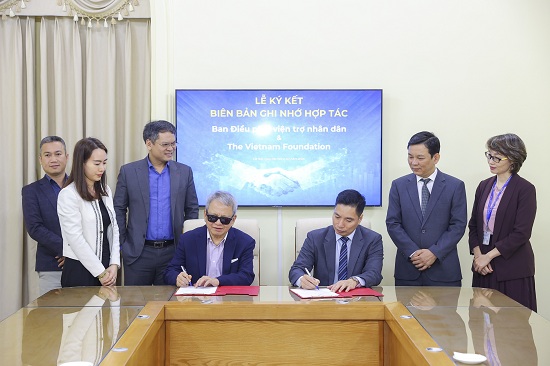
The signing ceremony of the MoU between PACCOM and The Vietnam Foundation (USA). (Photo: Dinh Hoa)
Digitizing Education in Disadvantaged Areas
Speaking at the ceremony, Mr. Dong Huy Cuong, Vice President of the Vietnam Union of Friendship Organizations, emphasized that digital learning platforms like KAV will create an ecosystem connecting teachers and students nationwide. Through this, border students can self-study Mathematics, Science, and English according to international standards while staying aligned with the 2018 General Education Program.
A Long-term Commitment
Mr. Pham Duc Trung Kien, Chairman of VNF, affirmed that supporting these 248 border schools is a top priority. To ensure effectiveness, the program commits to:
- Intensive Training: Guiding teachers on how to utilize the digital platform from the very first weeks.
- Parallel Implementation: Introducing technology and modern learning methods into teaching as soon as the new schools begin operations.
Delegates taking a commemorative photo. (Photo: Dinh Hoa)
Currently, the “KAV Open School" model is present in 5,300 schools nationwide with over 25,000 participating teachers. The expansion to border communes is expected to transform newly built schools into modern educational hubs, keeping pace with global knowledge integration.
Source: VUFO