Building on its existing foundation, the merger of former Binh Phuoc Province into the newly established Dong Nai Province will further diversify the landscape of people-to-people diplomacy in Dong Nai in terms of geographic scope, target groups, organizational forms, and participating forces. Effectively promoting the role of people-to-people diplomacy will help foster a peaceful and friendly environment, providing strong support for Dong Nai Province’s socio-economic development in the years ahead.
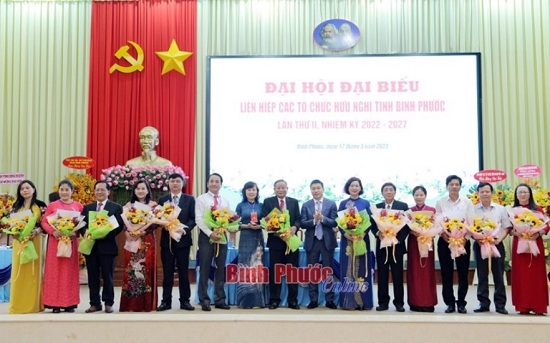
Following the merger, the landscape of people-to-people diplomacy in Dong Nai Province will become richer and more diverse.
Expanding the scope and forces of people-to-people diplomacy
Following the merger, Dong Nai Province now covers more than 12,700 km² with a population exceeding 4.4 million, becoming one of the leading provinces in the Southern region and nationwide in terms of area and population size. With its expanded space, Dong Nai holds a strategically important position in national defense and security, while also possessing favorable conditions to become a logistics, supply, transshipment, and production hub of Vietnam and the world through its port system and Long Thanh International Airport. As a result, Dong Nai continues to attract investors and develop industrial parks.
The administrative restructuring has also enriched the province's tangible and intangible cultural values of various ethnic communities. In addition, natural assets such as Cat Tien National Park, the Dong Nai and Bu Gia Map World Biosphere Reserves, Soc Bom Bo, and the art of gong culture provide a strong foundation for promoting and spreading Dong Nai's cultural identity regionally and globally.
Moreover, Dong Nai shares a 258.939 kilometer border with Cambodia, forming a new economic corridor that connects economic and cultural exchanges, serving as a gateway linking the Southeast region with the Central Highlands, the Mekong sub-region, and ASEAN.
With this expanded space, the forces engaged in people-to-people diplomacy will also grow stronger. Currently, Dong Nai has 10 friendship associations. These associations with the peoples of other countries are important partners in Vietnam's and Dong Nai's foreign policy. In recent years, they have effectively served as bridges fostering solidarity, friendship, and mutual understanding between Vietnam and other nations.
However, the global and regional context will pose numerous challenges to people-to-people diplomacy in the time ahead. In the draft documents for the 14th National Party Congress, alongside key principled contents inherited from the 13th National Party Congress, important new elements have been added, including the continued comprehensive and effective implementation of foreign affairs across three pillars: Party diplomacy, State diplomacy, and people-to-people diplomacy. This reflects expectations as well as affirmation of the role, position, and mission of people-to-people diplomacy in implementing foreign policy in the new context.
Dong Nai promotes people-to-people exchanges and cooperation
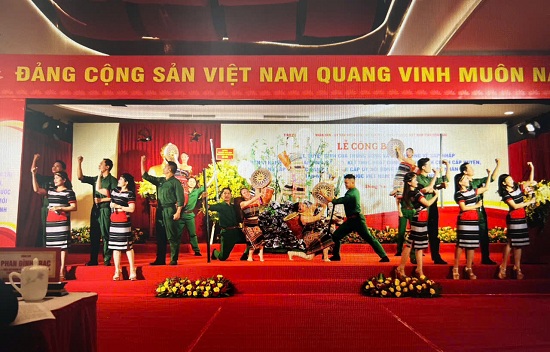
The musical performance “The Sound of Pestles in Soc Bom Bo” at the Ceremony announcing the Central and Provincial Resolutions and Decisions on the reorganization of the apparatus and administrative units of Dong Nai province. Photo: Huy Anh
To ensure that people-to-people diplomacy truly serves as an important pillar supporting Party diplomacy and State diplomacy, and to build upon the achievements of the Dong Nai and former Binh Phuoc Unions of Friendship Organizations, Dong Nai's people-to-people diplomacy in the new era will focus on the following tasks:
- Enhancing the role of the Dong Nai Union of Friendship Organizations in improving the quality of advisory work to the Provincial Party Committee, the Provincial People's Committee, and the Standing Committee of the Vietnam Fatherland Front of the province in issuing leadership and directive documents on people-to-people diplomacy.
- Strengthening dissemination, training, and capacity-building activities to ensure unified awareness and responsibility among officials and members within the Union system, as well as among civil servants and employees of provincial departments, agencies, and mass organizations regarding the role and importance of people-to-people diplomacy in the new context.
- Continuing to coordinate the comprehensive and effective implementation of foreign affairs across the three pillars: Party diplomacy, State diplomacy, and people-to-people diplomacy; promoting the pioneering role of foreign affairs in creating a peaceful environment, enhancing trade and investment promotion, and mobilizing resources for socio-economic development.
- Innovating the content and methods of people-to-people diplomacy activities; strengthening cultural diplomacy in conjunction with external information work to promote the image of the country and the people of Dong Nai to the world. Consolidating and expanding friendly relations with major partners and traditional friends in line with the Party's orientation; proactively building a peaceful, friendly, secure, cooperative, and development-oriented border; and nurturing friendship among younger generations between Vietnam and other countries.
- Advising the Standing Committee of the provincial Vietnam Fatherland Front on overseas Vietnamese affairs; organizing networking and information-sharing activities to encourage overseas Vietnamese to contribute, invest, and conduct business in their homeland, thereby contributing to the province's socio-economic development.
- Building a professional contingent of officials engaged in people-to-people diplomacy with strong political integrity and sufficient professional capacity to meet new requirements; while expanding and enhancing the quality and effectiveness of member associations.